
Think of the roof as a water path
Rain lands on the shingles, runs downhill across them, gets steered around anything that sticks up through the roof, and leaves at the edge into the gutter. Each step has a part that handles it. When one of those parts is missing, bent, worn out or installed in the wrong order, water finds the gap.
Flashing
Flashing is thin metal, or sometimes a flexible membrane, used wherever the roof meets something that interrupts the shingles. It's layered so water always runs over it and away, never behind it.
- Step flashing: individual pieces woven in with each shingle course where a roof slope meets a side wall.
- Counterflashing: metal set into or over the wall or chimney that covers the top of the step flashing.
- Chimney flashing: a combination of base, step and counterflashing around all four sides, often with a small cricket on the uphill side of wide chimneys.
- Valley flashing: metal or membrane along the valleys where two roof planes meet and water concentrates.
- Pipe boots and vent collars: fitted flashing around plumbing vents and exhaust vents.
- Skylight flashing: usually a kit designed for that specific skylight.
Flashing is where a lot of shortcuts hide. A thick bead of sealant can stop a leak for a while, but it isn't a substitute for properly layered flashing. On a replacement, ask which flashing will be replaced and which, if any, will be reused.
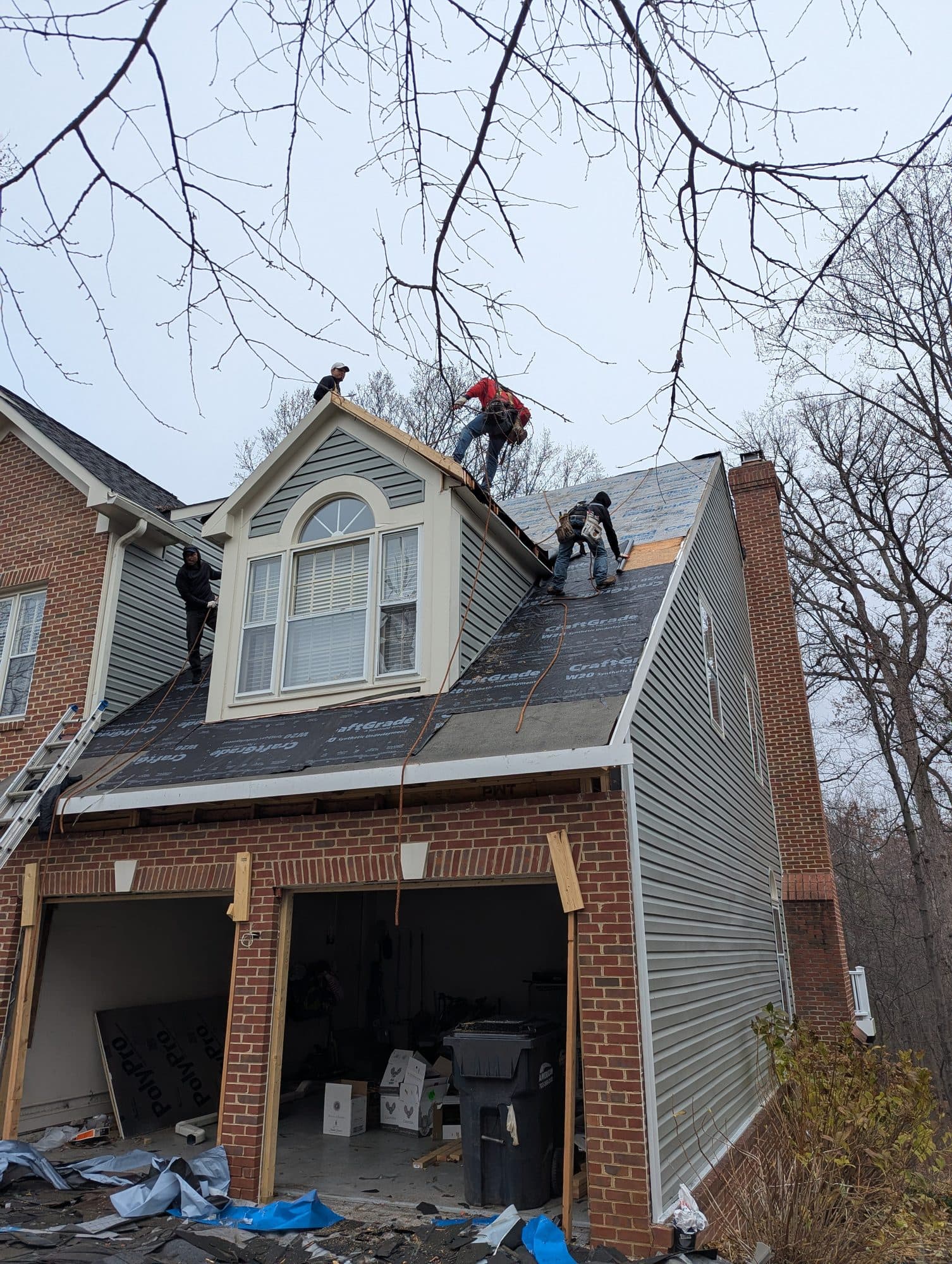
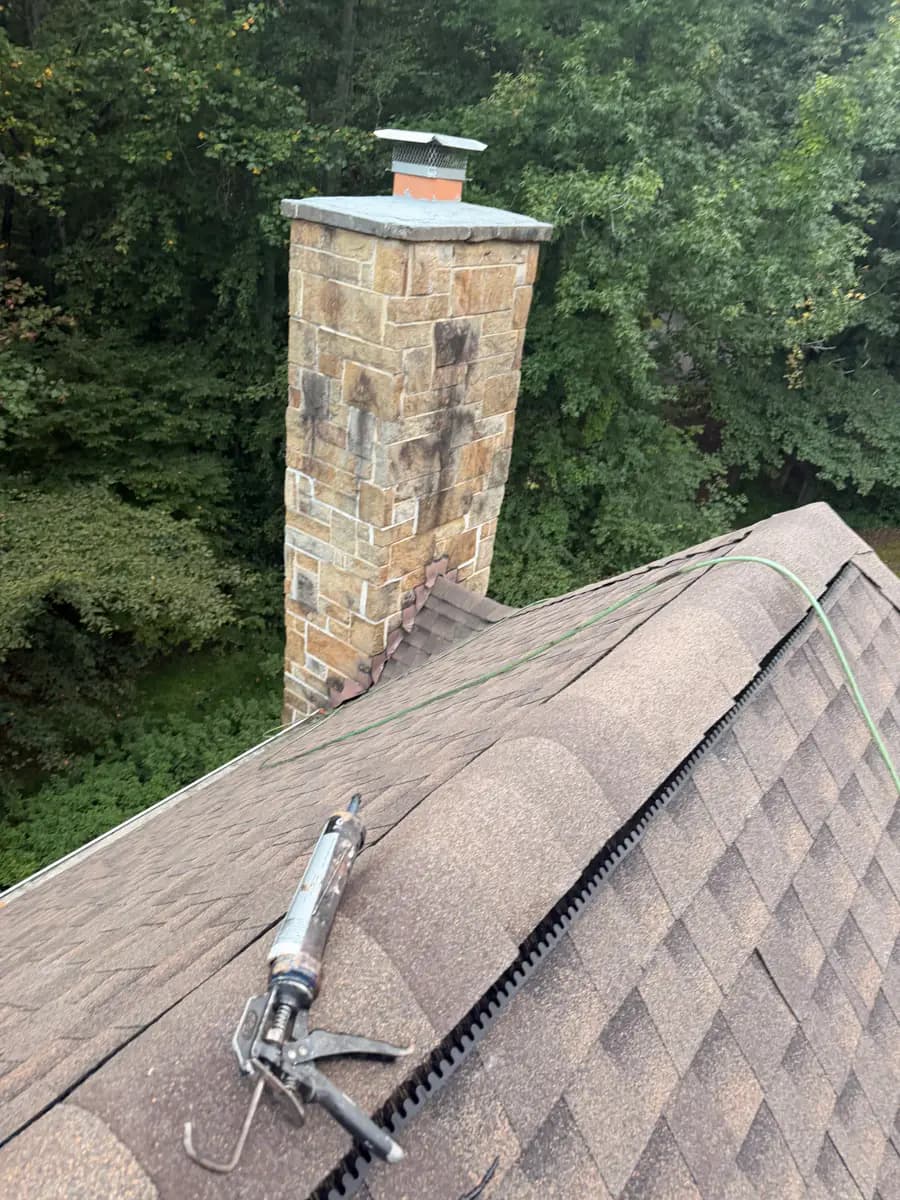
Flashing at a dormer and chimney on a Roofing Roughnecks re-roof in Reston, and a stone chimney and ridge detail on a project in McLean.
Drip edge
Drip edge is an L-shaped metal strip along the edges of the roof: the eaves, where the gutters are, and the rakes, the sloped edges at the gable ends. It holds the shingle edge, protects the edge of the roof deck, and directs water out into the gutter instead of letting it curl back under the shingles and soak the fascia board. Its relationship to the underlayment matters too: at the eaves and rakes, the layers need to overlap in the right order so water stays on top.
Older roofs sometimes have no drip edge, or a short piece that doesn't reach the gutter. Rotted fascia and stains behind the gutter are clues. Ask whether drip edge is included in your roof scope, and where.
Gutters and the roof edge
Gutters carry roof water to downspouts and away from the foundation. When they clog with leaves, water backs up, spills over the front or, worse, runs behind the gutter and into the fascia. In winter, a clogged gutter can hold ice at the edge of the roof. Keeping gutters clear is one of the simplest ways to protect a roof edge.
Roofing Roughnecks installs Leaf Relief gutter guards, a system designed to keep leaves and debris out while letting water flow through. Fairfax County's permit guidance lists gutters among residential work that doesn't need a building permit. Inside the Town of Herndon, check with the Town's Building Inspections office.
Where these parts meet: common trouble spots
- Roof-to-wall joints on split-levels and two-story homes, where a lower roof meets an upper wall.
- The low side of chimneys, where water piles up against the brick.
- Valleys that collect leaves and debris.
- The joint between townhouse roof sections, where one owner's roof meets the next.
- Eaves with missing drip edge or gutters pulled away from the fascia.
Many Herndon homes were built between 1970 and 2000, according to a town housing study reported in 2026, and some have been re-roofed more than once without the flashing being replaced. Those older flashing details are worth a close look whenever a roof is being worked on.
Questions to ask about your roof scope
- Which flashing is being replaced, and which is reused?
- Is drip edge included at the eaves and rakes?
- How are valleys being handled?
- Are pipe boots and vent collars being replaced?
- Is anything about the gutters or gutter guards included?
Related pages
Is roof sealant enough to fix a flashing leak?▸
Usually only as a short-term measure. Lasting repairs depend on flashing that's layered correctly so water runs over it and away.
What does drip edge do?▸
It holds the shingle edge, protects the edge of the roof deck, and directs water into the gutter instead of behind it.
Do clogged gutters damage a roof?▸
They can. Backed-up water can run behind the gutter into the fascia and roof edge, and in winter can hold ice at the eaves.
Do you install gutter guards?▸
Roofing Roughnecks installs Leaf Relief gutter guards.